France and Its Dead: A Sacred Bond Across Centuries
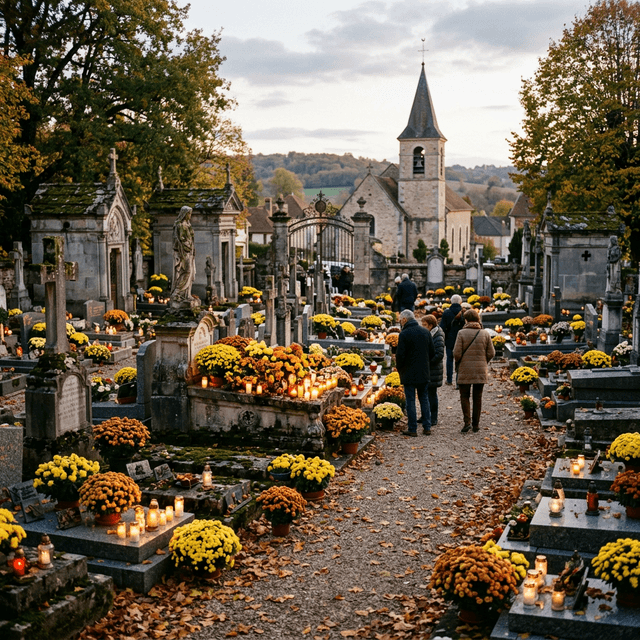
Every year on November 1st, all of France pauses to remember. Millions of families cross the country to visit cemeteries, arms laden with autumn-colored chrysanthemums. Toussaint is not just a public holiday — it is a national ritual, a moment when France tells its departed that they are not forgotten. With nearly 660,000 deaths per year — about 1,800 per day — the question of memory is deeply woven into French culture.
Toussaint: More Than a Tradition
Toussaint, celebrated on November 1st, is the most significant moment in the French memorial calendar. While rooted in Catholic tradition — a celebration of all saints — it has evolved over generations into a universal, secular observance. On this day, whether religious or not, people honor those who have left.
Chrysanthemums play a central role. This autumn flower, symbolizing longevity and eternity, adorns graves in bursts of yellow, orange, and white. It is a simple yet meaningful gesture: placing a pot of chrysanthemums says "I'm thinking of you, you're still here."
But Toussaint extends beyond the cemetery. In villages, families gather around a meal. They share the deceased's favorite dishes, open a bottle they would have enjoyed, and tell their stories. The French call this "la mémoire vivante" (living memory): keeping the dead alive through everyday gestures.
The Black Book: Neighborhood Solidarity
In some regions of France, particularly in the countryside, a tradition endures: the cahier noir (black book). When a death occurs, a condolence book is placed in front of the grieving family's door. Neighbors, friends, and passersby write words of support, memories, and anecdotes.
This discreet yet profound gesture illustrates an essential dimension of grief in France: community. One does not die alone, and one does not grieve alone.
Between Catholicism and Secularism: The Evolution of Ceremonies
Historically, French funerals followed strict religious protocols. Today, civil ceremonies are on the rise, driven by an increasingly secular society. These modern ceremonies focus on personalization: reading chosen poems, playing the deceased's favorite music, and hearing testimonies from loved ones. It is less a religious farewell than a celebration of the life that was lived.
French law requires funerals to take place within six days of death, creating a particular intensity in both organization and mourning.
The French Funeral Market: A Sector in Transformation
The funeral services market in France represents approximately €2.5 billion per year. Cremation, once marginal, now accounts for over 40% of choices. Pre-paid funeral contracts are becoming commonplace. And digital memorial platforms are answering a new need: honoring the departed beyond geographical boundaries.
Memory in the Digital Age
Families are increasingly scattered across the globe. Gathering at the cemetery on Toussaint isn't always possible. This is where platforms like Posterity become meaningful — extending the tradition of the cahier noir into the digital world, allowing family members in New York, Tokyo, and Marseille to gather and share memories together.
The concept of "living memory" finds a natural extension in digital tools. Honoring someone isn't just visiting a grave once a year — it's being able to reread their words, view their photos, and hear their voice at any moment.
Conclusion: Memory Knows No Borders
France possesses one of the richest cultures of mourning in the world. From Toussaint to the black book, from Catholic mass to personalized civil ceremonies, every tradition carries the same message: those we have loved must not be forgotten. Today, digital tools offer a new way to carry that memory — not to replace the chrysanthemums, but to complement them.