2030: Every grave has its digital alter ego
In less than five years, commemorative QR codes will be commonplace. Still perceived as a curiosity today, they will become as natural as flowers placed on a grave. By scanning a simple code engraved on a stele, visitors will instantly access the deceased's complete memorial space: their biography, photos, videos, and testimonials from loved ones.
Augmented reality will take its first steps in physical cemeteries. By pointing your phone at a grave, you will see — superimposed on reality — photos of a smile, the sound of a recorded laugh, a video message left during their lifetime. The physical cemetery and the digital cemetery will no longer be two separate worlds, but two sides of the same coin.
The first 3D tributes will appear: spatial reconstructions from hundreds of photos, allowing you to "walk" through a modeled place of memory — a grandparent's kitchen, a childhood garden, a craftsman's workshop.
2050: Visiting the dead in virtual reality
By 2050, the boundary between memory and immersion will have disappeared. Digital cemeteries will have become immersive spaces accessible in virtual reality.
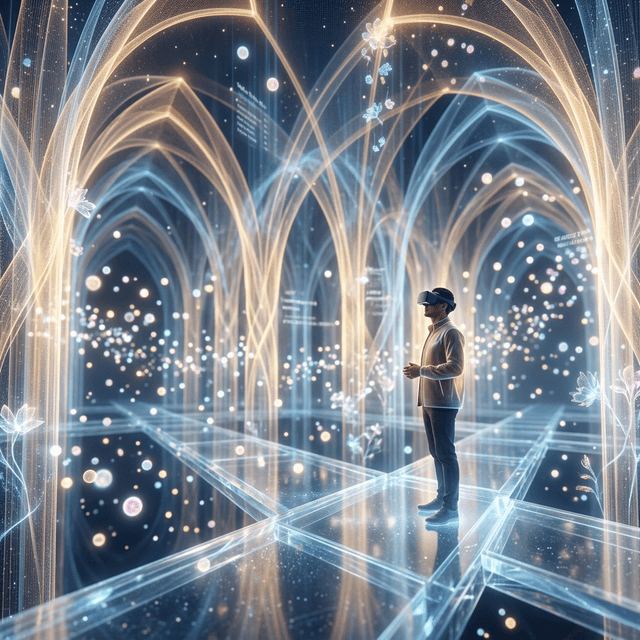
Imagine putting on a VR headset and finding yourself in a vast luminous space, a cathedral of light and silence, where each floating star represents a preserved life. You approach a star, and the space transforms: you are in your grandmother's living room. Her photos cover the walls. Her voice, reconstructed by artificial intelligence from her voice recordings, welcomes you.
Holograms from videos and photos will become commonplace. From a few dozen seconds of video and hundreds of photos, AI will be able to generate a realistic hologram of the deceased — not to resurrect them, but to allow a last gesture of farewell, a last moment of visual presence.
Reconstructive voice AI will allow hearing a loved one's voice from a few recordings. Not to converse with them, but to listen again to an "I love you", a lullaby, advice they would have given you. Technology in the service of consolation, not substitution.
Time capsules will become immersive experiences: instead of receiving a simple text message on a chosen date, the recipient will be immersed in a virtual environment designed by the sender — a sunset on a beach, a fireplace in winter, a bench in a park in spring — with the message broadcast as if the person were beside them.
2100: Consciousness transferred?
Let us now enter the territory of science fiction. By 2100, technology will have reached a level we can barely imagine. And the questions it raises will be as much philosophical as technological.
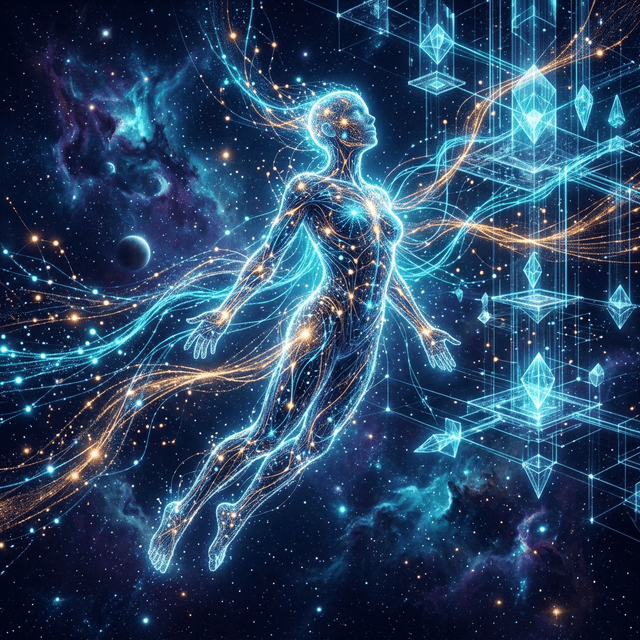
Consciousness transfer — long confined to science fiction — could become a technological reality. Researchers are already working on the complete neural mapping of a human brain. By 2100, it may be possible to digitize a person's neural connections and "transfer" them to a digital space. The question will no longer be "can we do it?" but "should we do it?"
Conversing with the dead? Artificial intelligences trained on all the writings, videos, voice recordings and messages of a deceased person could reproduce their communication style with disturbing fidelity. You could ask a question and receive an answer that they themselves would probably have given. The AI would not be the person — but it would be their most faithful echo ever created.
Eternal digital clones in the metaverse would represent the ultimate step: permanent avatars, endowed with the memory, personality and communication style of the deceased, living in a persistent digital space. True "digital ghosts" with whom descendants could interact for centuries.
Orbital cemeteries — data servers placed in Earth orbit, powered by solar energy — could preserve the memory of all humanity for millennia, safe from terrestrial catastrophes. Human memory, literally projected into the stars.
Knowing how to let go of those who have gone
Technology may be able to reproduce everything. But the real question is not "can we?" but "should we?"
Everything described in this article will be technically possible. Voice AI, holograms, digital clones, perhaps even consciousness transfer. Science marches on, inexorably.
But memory does not need to be alive to be eternal.
digital cemetery is not made to simulate a presence. It is made to honor a life. Preserve a memory, not reproduce a person. Transmit a story, not create an illusion.
The most beautiful proof of love, sometimes, is knowing how to let go of those who have gone. To keep their memory alive in our hearts and in a dedicated space — without trying to artificially hold them in a world that is no longer theirs.
Posterity — Posterity chooses preservation, not simulation. The beauty of memory lies in its immutable nature: a photo, a voice, a moment frozen in time. Not a simulacrum that pretends death did not happen.
Memory does not need to be alive to be eternal. It needs to be true.